
Job analysis: Diversity and change managers are most in demand here
- Berlin School of Business and Innovation (BSBI) analyses diversity and change managers are most in demand in Germany
- Demand highest among Munich-based companies
- Seven cities from North Rhine-Westphalia in the top 10
- Industry comparison: IT versus advertising industry
In the modern working world, diversity, and change management play a decisive role in shaping sustainable and diverse companies. According to a survey by the Ifo Institute and the job platform Indeed, diversity gives companies an advantage in the race for staff, for example. Nevertheless, only a few companies in Germany are taking the initiative and hiring diversity and change managers. We at Berlin School of Business and Innovation have analysed the job vacancies for diversity and change managers in the 20 largest German cities. There are clear differences both regionally and between industries.
Demand highest among Munich-based companies
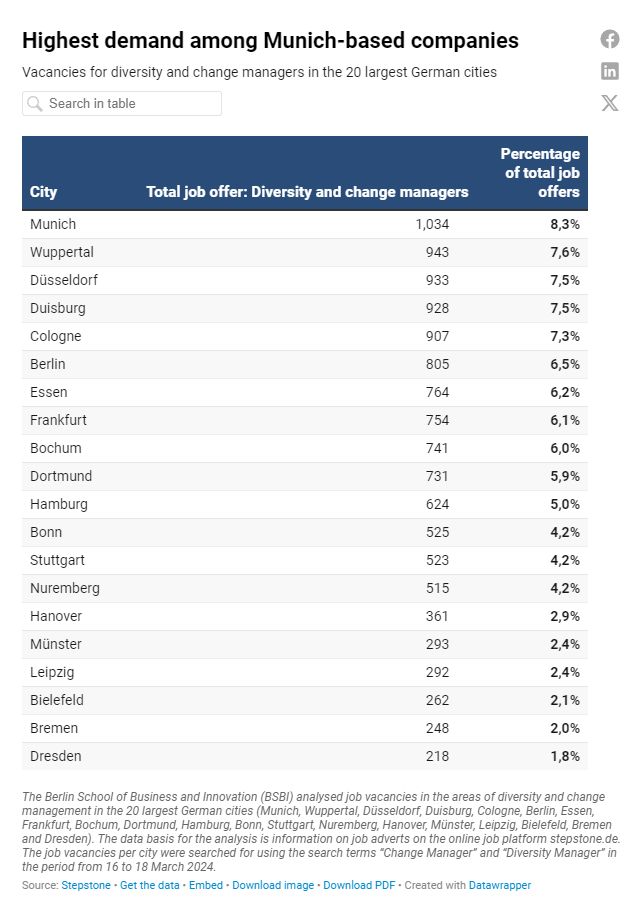
With 1,034 job offers for diversity and change managers, the Bavarian capital of Munich leads the nationwide ranking. This corresponds to a share of around 8.3 per cent of all job offers in both categories. The distribution of both job categories in the various companies is roughly equal. Wuppertal follows in second place with a total of 943 job advertisements (around 7.6 per cent), while the neighbouring cities of Düsseldorf and Duisburg share third place, each with a share of around 7.5 per cent of total job advertisements. Cologne is in fourth place with 907 jobs (around 7.3 per cent) in both categories.
According to the job platform analysis, companies in Bielefeld, Bremen, and Dresden are hardly looking for diversity or change managers. The three cities combined have just 728 vacancies, accounting for only around 5.8 per cent of the total number of jobs on offer.
Seven cities from North Rhine-Westphalia in the top 10
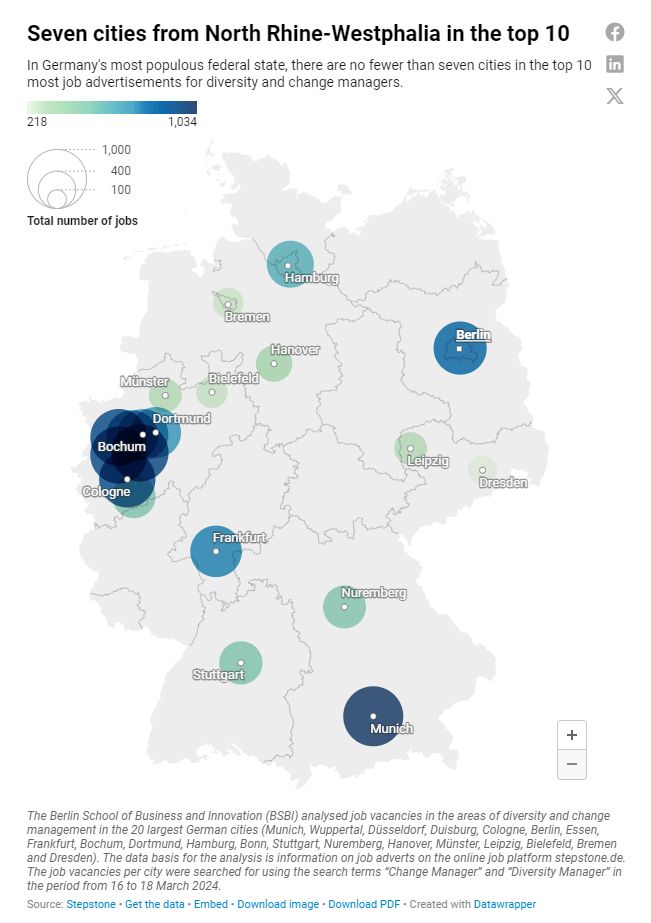
In Germany’s most populous federal state, there are no fewer than seven cities in the top 10 for most job advertisements for diversity and change managers. In addition to those already mentioned (Wuppertal, Düsseldorf, Duisburg, and Cologne), there are three other cities in NRW. Essen is in seventh place with 764 job advertisements (around 6.1 per cent), closely followed by Bochum in eighth place with a share of around 6 per cent. Dortmund closes out the top 10: here, companies are looking for new employees in the field of diversity and change management, with a total of 731 job advertisements (around 5.9 per cent).
Industry comparison: IT is looking for the most — almost no jobs in the advertising industry
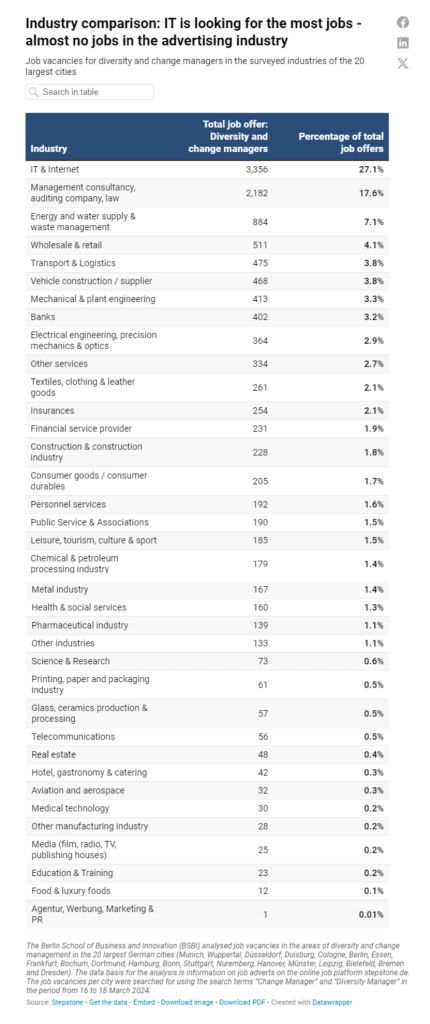
With a total of 3,356 vacancies (around 27 per cent), the IT sector is currently investing the most in its search for diversity or change managers. Management consultancies (a total of 2,182 jobs, around 17.6 per cent) and energy and water supply (a total of 884 jobs, around 7.1 per cent) follow in second and third place. In contrast, all other sectors analysed fall off sharply in comparison: in the system-relevant sectors, wholesale and retail still has the largest share at around 4.1 percent and is therefore well ahead of the service sector (around 2.7 percent). The public sector (around 1.5 per cent) and the healthcare sector (around 1.3 per cent) show a dwindling number of job offers for diversity and change managers. The advertising industry is in last place in the ranking with one job advert.
About the investigation
The Berlin School of Business and Innovation (BSBI) analysed job vacancies in the areas of diversity and change management in the 20 largest German cities (Munich, Wuppertal, Düsseldorf, Duisburg, Cologne, Berlin, Essen, Frankfurt, Bochum, Dortmund, Hamburg, Bonn, Stuttgart, Nuremberg, Hanover, Münster, Leipzig, Bielefeld, Bremen and Dresden). The data basis for the analysis is information on job adverts on the online job platform stepstone.de. The job vacancies per city were searched for using the search terms “Change Manager” and “Diversity Manager” in the period from 16 to 18 March 2024.
About the Berlin School of Business and Innovation
The Berlin School of Business and Innovation (BSBI) is a private business school with headquarters in Berlin and locations in Paris, Athens, Hamburg and Barcelona. Since its opening in spring 2018, it has been offering its students English-language Bachelor’s and Master’s degree programmes in the fields of business administration, marketing, finance, tourism and hospitality event management. The programme combines blended learning with traditional teaching and is attended by more than 5,400 students and around 2,000 alumni from 104 countries. To ensure the international orientation of the school, BSBI cooperates with various academic partners and is registered as an Erasmus+ organisation. BSBI is also part of GUS Germany GmbH (GGG), a dynamic network of higher education institutions with more than 18,000 students at locations in Germany, Europe and beyond. You can also find up-to-date information about BSBI on Instagram, Facebook, Twitter, YouTube, LinkedIn and TikTok.