
What is Entrepreneurship? A Complete Guide for Aspiring Entrepreneurs
Around 665 million people worldwide are currently engaged in entrepreneurial activity, and that number keeps climbing. Whether you’re weighing up your career options, thinking about launching a business, or simply curious about what drives people to build something from scratch, understanding what entrepreneurship is and how it actually works is a solid place to start.
This guide covers everything: the definition, the different types of entrepreneurship, the characteristics of entrepreneurs who succeed, a step-by-step path on how to become an entrepreneur and why a formal qualification, like the programmes offered at BSBI School of Innovation can give you a genuine advantage.
What is Entrepreneurship?
Entrepreneurship is the process of creating, organising and managing a business venture, with all the risk and reward that brings.
The concept goes back centuries, but it was French economist Jean-Baptiste Say who first described an entrepreneur as someone who ‘shifts economic resources out of an area of lower productivity into an area of higher productivity and greater yield.’ That definition still holds. Today, though, it encompasses everything from launching a local bakery to scaling a tech startup that serves millions.
Who is an Entrepreneur?
A simple answer: an entrepreneur is someone who identifies an opportunity, takes the initiative to act on it, and accepts personal responsibility for the outcome. But that description barely scratches the surface.
According to 2025 data, around 62% of entrepreneurs hold a bachelor’s degree, though many of the world’s most recognisable entrepreneurs never completed a formal qualification. What unites them is less about credentials and more about mindset: curiosity, persistence, and a willingness to move before everything is perfectly aligned.
Entrepreneur vs Entrepreneurship
These terms are often used interchangeably, but they’re not the same. An entrepreneur is the person — the individual who takes the leap. Entrepreneurship is the broader process and discipline that describes what they do and how they do it.
Think of it this way: entrepreneurship is the sport; the entrepreneur is the athlete. One is the system, the other is the person navigating it. Understanding this distinction matters, especially if you’re considering a career in entrepreneurship or studying it formally, because it shapes how you think about strategy, risk, and growth.
What are the Types of Entrepreneurship?
Not all entrepreneurs are trying to build the next unicorn. The Knowledge Academy identifies several distinct types of entrepreneurship, each with different goals, scales, and risk profiles:
- Small Business Entrepreneurship: The backbone of most economies. Think local restaurants, independent retailers, and family-run service providers. Profit over scale; community over growth at any cost.
- Scalable Startup Entrepreneurship: Built to grow fast. These ventures, often tech-driven, aim to disrupt existing markets and attract venture capital. Think early-stage fintech, SaaS or AI tools.
- Large Company Entrepreneurship: Also called intrapreneurship. Here, existing businesses create new products, divisions or models. Google X and Amazon Lab126 are classic examples.
- Social Entrepreneurship: Profit isn’t the primary metric. Social entrepreneurs build organisations designed to address societal problems — poverty, access to education and environmental degradation.
- Innovative Entrepreneurship: Driven by original ideas and R&D. These entrepreneurs create genuinely new products or methods — not iterations, but breakthroughs.
- Hustler Entrepreneurship: Less reliant on capital, more dependent on grit. Hustler entrepreneurs start small, reinvest everything and grow through sheer effort and persistence.
- Serial Entrepreneurship: These individuals launch, grow, exit and start again. They thrive on the early-stage energy of building new ventures rather than running established ones.
- Lifestyle Entrepreneurship: The business exists to fund a specific way of life — freedom, travel, creative work. Growth is less about scale and more about sustainability and personal alignment.
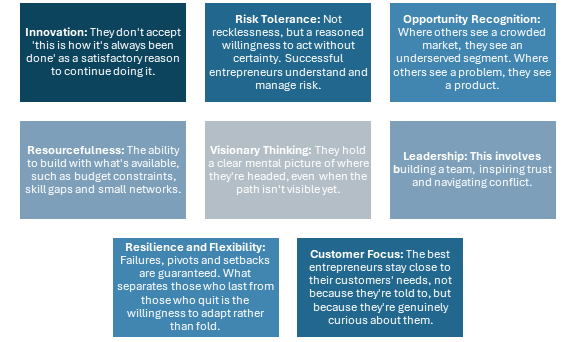
Key Characteristics of Entrepreneurship
Ask ten successful entrepreneurs what made the difference and you’ll get ten different answers. Ask researchers, and certain patterns emerge. The characteristics of entrepreneurs who build lasting ventures tend to cluster around a consistent set of traits:
How to Become an Entrepreneur: Step-by-Step
Wix’s guide on how to become an entrepreneur and Zell Education’s introduction to entrepreneurship both make a similar point: there’s no single route, but there is a process. Here’s a structured approach to how to become an entrepreneur:
- Build the Right Skills and Mindset: Before the idea, before the plan — work on you. Develop financial literacy, improve your communication and get comfortable with uncertainty.
- Find a Strong Business Idea: This doesn’t have to be revolutionary. Look for genuine pain points; problems you’ve experienced firsthand or gaps you’ve observed in markets you know.
- Understand Your Target Market: Who are you actually building for? Get specific. Demographics, behaviours, motivations and frustrations. Know them better than your competitors do.
- Validate and Test Your Idea: Don’t spend months building before you know if anyone wants it. Run surveys, conduct interviews, test a landing page.
- Create a Clear Business Plan: A plan keeps you honest about assumptions and accountable to targets.
- Develop a Minimum Viable Product (MVP): Your first version doesn’t need to be perfect. It needs to be functional enough to learn from. Ship, measure, iterate.
- Build a Network: LinkedIn’s global survey revealed that 61% of all professionals agree that regular online interaction with their network can lead to new job opportunities.
- Secure Funding and Manage Finances: Understand your options like bootstrapping, angel investment, grants, bank loans or venture capital. Cash flow is the single most common reason businesses fail; manage it obsessively.
- Build Your Brand and Online Presence: Your brand is how the world perceives you before you ever speak to them. Invest in it early. 82% of consumers use social platforms to discover and research products, so your digital presence is not optional.
- Launch, Learn, and Continuously Improve: A launch is a beginning, not a finish line. Build systems for gathering feedback, stay close to your data and never stop improving.
Essential Entrepreneurial Skills
Beyond traits and mindset, entrepreneurial skills are the practical capabilities that translate ideas into functioning businesses. Zell Education’s research on entrepreneurship highlights several that consistently separate founders who scale from those who stall:
- Financial Management: Understanding margins, burn rates, cash flow and basic accounting isn’t optional for a founder; it’s survival knowledge.
- Marketing and Sales: Even the best product needs a customer. Knowing how to communicate value, generate leads and close deals is non-negotiable.
- Communication Skills: You’ll need to pitch investors, convince early customers, align a team and negotiate with suppliers; all requiring clear, confident communication.
- Problem-Solving: Entrepreneurship is essentially applied problem-solving under time pressure and resource constraints. This is one of the skills needed to become an entrepreneur that practice builds better than any textbook.
- Negotiation and Networking: Whether securing your first office lease or closing a partnership deal, negotiation skills pay dividends at every stage.
- People Management: Your ability to hire well, retain talent and build a culture that gets results becomes increasingly important as you grow.
- Time Management and Productivity: As a founder, your time is your scarcest resource. Learning to protect it and use it on the tasks that move the needle is a career in entrepreneurship fundamental.
The Role of AI in Becoming a Successful Entrepreneur
The role of AI in entrepreneurship has shifted from curiosity to competitive necessity. According to recent SBE Council data, 82% of small business owners have already adopted at least one AI tool — and those businesses report saving a median of 5 hours per week in founder time alone. That’s not trivial when you’re building something from scratch.
Entrepreneurs are using AI to write and test marketing copy, analyse customer behaviour, automate routine processes and even conduct market research that previously required dedicated teams.
The most immediate applications for early-stage founders include:
- Market Research and Competitor Analysis: AI tools can synthesise vast amounts of data in minutes, surfacing trends and gaps that manual research would take weeks to uncover.
- Content and Copy Creation: From website copy to email sequences to pitch decks, AI dramatically reduces the time and cost of producing professional-quality materials.
- Customer Service Automation: Chatbots and AI-powered support tools allow even solo founders to offer responsive, consistent customer service around the clock.
- Financial Forecasting: AI-driven tools can help entrepreneurs model different financial scenarios, stress-test assumptions and identify cash flow risks before they become crises.
- Product Development: From ideation to prototyping, AI tools are compressing product development timelines, allowing small teams to operate like much larger ones.
A Springer Nature study on AI in entrepreneurial ventures found statistically significant effects of AI capabilities on decision-making, innovation, risk mitigation and competitive advantage. In plain terms: the entrepreneurs who are learning to use these tools well are pulling ahead.
The GEM 2025/2026 Global Report identified an expanding ‘AI Readiness Gap’, which is a widening divide between entrepreneurs with genuine AI capabilities and those who haven’t yet developed them. Closing that gap sooner rather than later is one of the clearest advantages a business education can offer.
Benefits and Challenges of Entrepreneurship
There’s no honest conversation about entrepreneurship benefits without acknowledging what actually makes it hard. Here’s a clear-eyed look at both sides:
The Benefits
- Autonomy: You set the direction, the culture, and the pace. That freedom is one of the most cited reasons people choose an entrepreneurial career.
- Financial Upside: Uncapped earnings potential; your income is tied to the value you create, not a salary band someone else sets.
- Personal Growth: Few experiences compress learning like running your own venture. You’ll develop entrepreneurial skills across finance, leadership, sales and strategy simultaneously.
- Social and Economic Impact: Small and medium-sized enterprises account for 90% of businesses globally and employ 60-70% of the workforce. Entrepreneurs build economies.
- Purpose: Building something aligned with your values, whether a profitable business or a social enterprise, creates a different kind of satisfaction than employment alone.
The Challenges
- Financial Risk: Capital is rarely guaranteed. Cashflow problems remain the leading cause of startup failure, with roughly 10% of new businesses across most industries not making it through their first year.
- Stress and Burnout: The psychological weight of ownership, especially in early stages, is real and should not be underestimated.
- Isolation: Particularly for solo founders, the lack of colleagues and daily structure can be harder to manage than the work itself.
- Uncertainty: Markets shift, competitors emerge, regulations change. Building tolerance for ambiguity is less a preference and more a prerequisite.
- Scaling Difficulties: Around 78% of companies that have successfully built a product and found product market fit (PMF) fail to scale.
Begin Your Path to Entrepreneurship with a BSBI Programme
If you’re serious about building a career in entrepreneurship, structured education can quicken the journey considerably. The MA in Innovation and Entrepreneurship at BSBI School of Business and Innovation is designed precisely for this; merging business theory with real application in one of Europe’s most active startup ecosystems.
Located in Berlin, which is ranked 7th in the world’s top 10 student cities, BSBI offers an internationally accredited postgraduate programme that instils you with the confidence to start your own business and become a leader in innovation within your own organisation. You’ll know how to tackle ethical issues and to overcome any challenges posed by a globalised environment.
You may also have the opportunity to learn German for free alongside your programme of study to improve your employability prospects.
Whether you’re building your first business idea or looking to lead innovation within an established organisation, the right programme gives you the frameworks, mentorship and a peer network that compounds in value over time.
Ready to take the next step? Contact us to know more.
Conclusion
Entrepreneurship is one of the most demanding and rewarding things a person can choose to pursue. It requires real entrepreneurial skills, a clear understanding of the types of entrepreneurship and an honest appreciation of both its benefits and its challenges.
What makes the difference, consistently, is preparation. The entrepreneurs who last are not necessarily the most talented or the most funded; they’re the most informed, the most connected and the most willing to keep learning. That’s precisely what a strong educational foundation, and the community around it, makes possible.
BSBI School of Business and Innovation is built to support exactly that kind of ambition. If you’re ready to take the next step, the MA in Innovation and Entrepreneurship is worth some serious consideration.