Game Design Requirements: What You Need to Know Before You Apply
The global video game industry surpassed $260 billion in 2025 and is projected to reach $320 billion by 2030 — and it shows no sign of stopping. Behind every game that grips a player for hours are writers, artists, programmers, and, above all, designers who make it all feel alive.
But what does it actually take to get onto a game design degree? What game design requirements do universities look for? What skills for game design should you bring to the table and how should your game design portfolio look before you send that application?
Whether you’re preparing your first application or deciding if a postgraduate route is right for you, here is a clear, honest breakdown of everything you need to know.
What Is a Game Design Degree?
A game design degree is an academic programme that trains students to conceive, develop and produce video games at a professional level.
At BSBI, the MA Game Design programme brings together creative vision and technical discipline, giving graduates the foundation to work in studios, go independent, or push into emerging areas like XR and AI-driven game development.
Students can expect to learn:
- Create innovative game concepts, prototypes, and experiences.
- Core game design principles, tools, and techniques.
- Game mechanics, dynamics, and player experience.
- Industry-relevant methods and frameworks.
- Key theories shaping modern game design.
- Skills for careers in the creative industries.
Entry Requirements for Game Design Degrees
Understanding the game design entry requirements before you apply will save you time and help you put together a much stronger application. Requirements vary by institution and level of study, but there are consistent expectations across the board.
1. Academic Qualifications
For undergraduate programmes, applicants need a high school diploma or equivalent qualification. For postgraduate programmes like the MA Game Design at BSBI, a relevant bachelor’s degree is typically expected.
2. Language Proficiency (IELTS/TOEFL)
International applicants are required to demonstrate English language competency. The standard benchmarks are:
- A minimum IELTS Academic score of 6.0 overall, with at least 5.5 in each component, or an equivalent qualification demonstrating B2-level English language proficiency, is required.
- Please note: Some countries may have specific visa requirements regarding acceptable evidence of English language proficiency. We therefore advise applicants to check the relevant visa requirements for their country of application.
If your previous education was delivered in English, many universities will accept that as proof of proficiency. Always check the specific institution’s policy.
3. Portfolio
A game design portfolio is often the most scrutinised part of your application. It does not need to be extensive, but it must be intentional. Admissions teams want to see that you think like a designer and that you can take an idea and work it through to something tangible.
4. Personal Statement
This is your chance to explain why game design — why now, and why this programme. Be specific. Generic enthusiasm is easy to spot. Talk about games that have influenced you, problems in design that fascinate you or projects you have already worked on.
5. Transcripts and Supporting Documents
- Official academic transcripts (translated into English where required).
- Two letters of recommendation — from academic tutors or professional mentors.
- Copy of passport or valid photo ID.
- CV or résumé (especially relevant for postgraduate applicants).
Key Skills Required for Game Design Students
Before you even look at the technical side, there are foundational game design skills that universities and studios consistently look for. These are not always things you learn in class — they are qualities you bring through your own curiosity and experience.
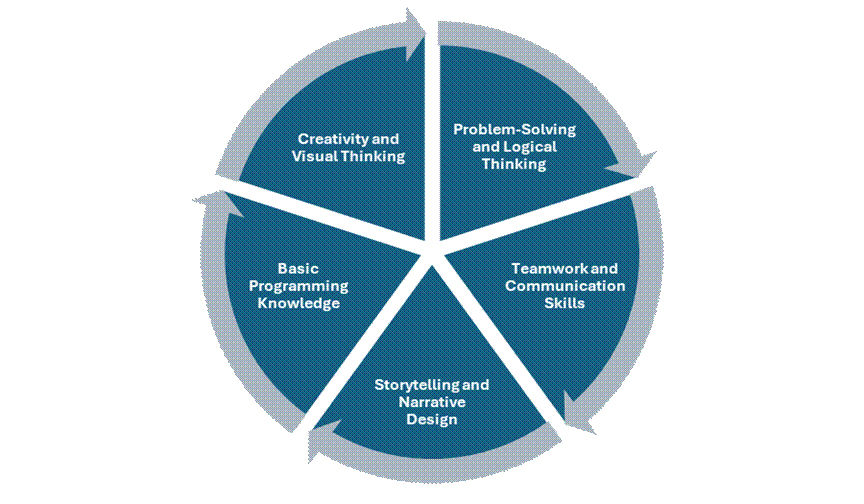
I. Creativity and Visual Thinking
Game designers are problem solvers who work visually. Being able to imagine a space, a character, or a mechanic before it exists on screen is central to the job.
II. Problem-Solving and Logical Thinking
Every game is a collection of interlocking systems. When something breaks, and in development, things frequently break, you need to diagnose the issue methodically and find a solution.
III. Storytelling and Narrative Design
The best games tell stories, even when the story is entirely in the mechanics. Understanding how narrative, environment, sound, and player choice combine to create meaning is one of the more nuanced skills for game design — and one of the most valued.
IV. Basic Programming Knowledge
You do not need to be a developer to study game design, but some familiarity with programming logic will help enormously.
V. Teamwork and Communication Skills
Game development is collaborative by nature. According to the International Game Developers Association, 80% of gaming industry professionals hold at least a college degree — but across the board, studios consistently rank communication and team skills among their top hiring criteria.
Top Technical Skills Required for Game Design Studies
Beyond creative ability, the game development skills required at degree level are technical. Students who arrive with some prior knowledge of the tools and technologies used in the industry will find the transition into studio-level work much smoother.
Here are the technical competencies that matter most:
- Game Engine Proficiency — Unity and Unreal Engine: These are the two dominant engines in the industry. Unity is widely used for mobile, indie, and cross-platform development. Unreal Engine leads in high-fidelity AAA production.
- 3D Modelling and Animation: Software like Blender, Maya, and ZBrush form the backbone of character and environment creation. Understanding 3D geometry, rigging, and animation principles gives designers the ability to build and iterate on their own assets.
- Programming Languages: C# (for Unity) and C++ (for Unreal) are the primary languages in game development. Python is increasingly used for tooling and scripting.
- Version Control and Collaboration Tools: Git and GitHub are industry standard for managing code and assets across teams. Understanding how version control works — how to branch, commit, and manage conflicts — reflects a professional mindset that admissions teams and studios respect.
- UX/UI Design Principles: Familiarity with UX principles and tools like Figma or Adobe XD demonstrates an awareness of player experience beyond the game world itself.
Essential AI Tools for Game Design Students and Graduates
AI has moved from a niche experiment to a standard part of the game development workflow. Students who understand how to use these tools effectively will be better prepared for the demands of a professional studio.
- Midjourney: An AI image generation platform that produces high-quality concept art and character visuals from text prompts.
- Unity Muse: Integrated directly into the Unity editor, Muse can generate textures, materials, and C# scripts through conversational prompts.
- GitHub Copilot: An AI pair programmer that works within code editors to suggest, complete, and debug code.
- Ludo.ai: A game research and ideation platform that analyses market trends, generates game concepts, and suggests matching assets.
- Scenario: An AI platform built specifically for game asset generation. Unlike generic image tools, Scenario can be fine-tuned on a custom art style, ensuring consistency across characters, environments and UI elements throughout a project.
Game Design Portfolio Requirements
Your game design portfolio is the single strongest signal you can send to an admissions team or employer. Grades tell one story. A portfolio shows what you actually do with your time.
According to Game Design Skills, while a portfolio is not always a hard requirement for admission, having one makes a real difference — both in terms of standing out and demonstrating the kind of commitment that degree programmes want to see.
Strong game design portfolios share some common qualities:
- They show a range of work: Not every piece needs to be finished, but each should demonstrate a clear design decision.
- They include processes: Sketches, wireframes, and documentation matter as much as the final product.
- They are curated: Five polished pieces beat fifteen average ones every time
- They are accessible: If the admissions team can’t open or play your work, it doesn’t exist
What to Include in a Game Design Portfolio?
1. Game Prototypes or Demo Projects
A playable prototype, however simple, demonstrates that you can see a design through to completion. Industry professionals consistently note that a polished five-minute prototype is more impressive than an ambitious unfinished project. Scope matters less than follow-through.
2. Concept Art and Character Design
Original character designs, environment concepts, or asset sheets show your visual vocabulary. Include your initial sketches alongside the refined versions; the design thinking behind the work is often more interesting than the outcome.
3. Level Design Examples
Annotated maps, spatial diagrams, or screenshots from a level you built in a game editor demonstrates your understanding of player flow, challenge pacing and environmental storytelling.
4. Storyboards or Game Narratives
A written game design document (GDD), a narrative outline, or a storyboard sequence shows how you think about structure and player experience over time.
5. Personal or Collaborative Projects
Game jam entries, mods, student collaborations, and independent experiments all count. Participating in game jams in particular demonstrates the ability to produce a finished product under constraints.
How to Prepare for a Game Design Degree Application?
The requirements to study game design are not impossible to meet, but they do reward preparation. Here is a practical approach to getting ready.
- Audit your skills honestly. Identify where you are confident and where you need work. Don’t wait for a course to teach you what you can learn independently.
- Build something. Download Unity or Unreal Engine (both free for students) and create a small prototype.
- Develop your portfolio iteratively. Start with what you have and improve it. Document your process — photographs of sketchbooks, version histories, design notes — all of it adds texture to your application.
- Research the programme thoroughly. Read the curriculum, look at what graduates are doing, and tailor your personal statement accordingly.
- Connect with the community. Join game development forums, attend online jams and engage with Discord communities around your preferred tools.
- Sort your language requirements early. If you need an IELTS or TOEFL score, give yourself enough time to prepare and re-sit if needed.
Conclusion
Getting onto a game design programme takes more than enthusiasm — it takes demonstrated ability, honest self-assessment, and deliberate preparation. The game design degree requirements across good institutions have never been about perfection.
Whether you are building your first portfolio, preparing your IELTS score, or weighing up the right programme, the work you put in before you apply is not wasted. It goes directly into the designer you become.
Ready to take the next step?