Economies compared: This is the situation regarding female representation in political institutions worldwide
Not special rights, but human rights: German women’s rights activist Clara Zetkin campaigned for equal rights for women over a hundred years ago. There has always been a growing global awareness of women’s rights and gender equality.
We at the Berlin School of Business and Innovation have examined the gender parity in the lower houses of parliament and parliaments, as well as in the bodies and committees on human rights and gender equality in the twenty countries with the highest gross domestic product. The data source was the IPU Parline website, a reference point for authoritative data on the world’s parliaments.
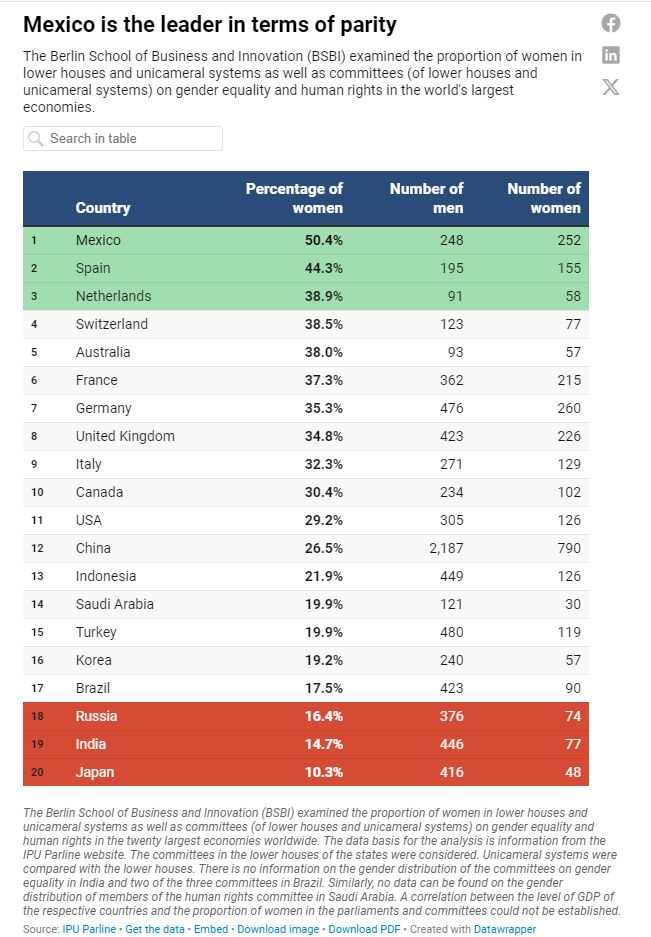
Mexico is the parity leader
The Central American country of Mexico takes first place in the ranking, with a percentage of female seats in its lower house of parliament of just over 50 per cent. Spain is in second place (around 44 per cent), closely followed by the Dutch lower house with 39 per cent. The island nation of Japan has the lowest proportion of women in the lower houses (around 10 per cent). Germany is well in the middle of the international rankings: the proportion of female political representatives in the German Bundestag (lower house) is around 35 per cent.
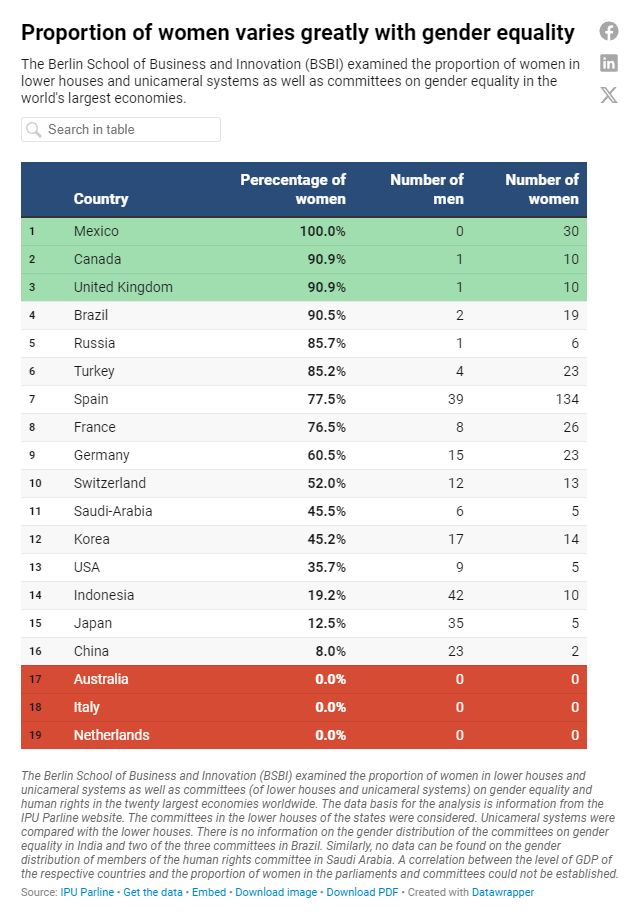
Proportion of women varies greatly with gender equality
In the majority of countries that have a parliamentary body working on gender equality, women are in the majority; on average, the proportion of women is just under 61 per cent. The number of such committees varies greatly. In the Spanish lower house, for example, almost 50 per cent of MPs sit on one of the three existing committees on gender equality. According to the IPU, these include the Commission for the Control and Evaluation of Laws against Gender Violence, the Commission for Labour, Inclusion, Social Security and Migration and the Gender Equality Commission. In Germany, only around 5 per cent of MPs sit on the Committee for Family Affairs, Senior Citizens, Women, and Youth. While Mexico has an all-female committee, in China only eight per cent of the members of the Social Development Committee are female. With 61 per cent women, Germany is right on average. In the lower houses of three economies, there is no separate parliamentary body for gender equality: Italy, the Netherlands and Australia.
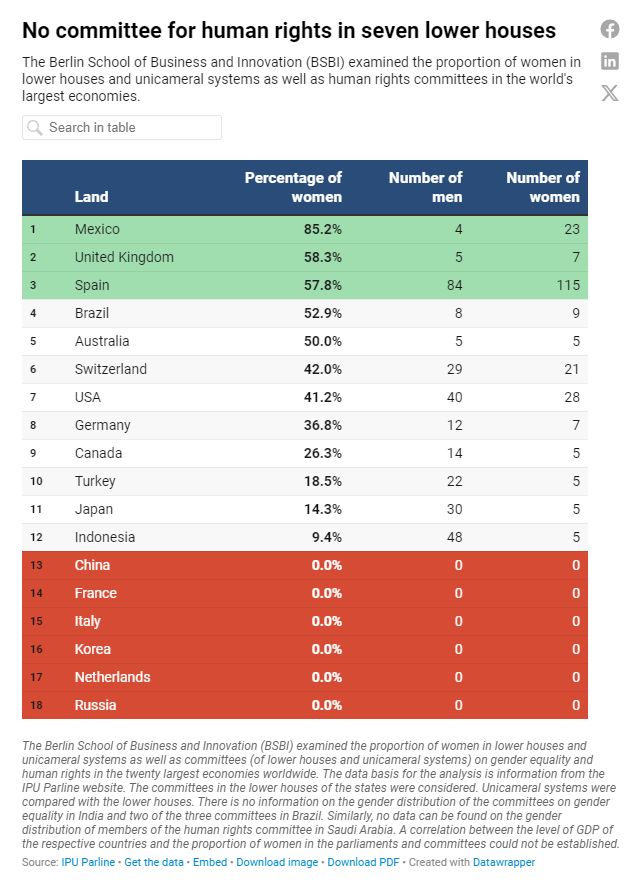
No committee for human rights in seven lower houses
When it comes to parliamentary committees on human rights, Spain is ahead of the pack. Here, more than half (around 57 per cent) of all members of the lower house of parliament sit on four different committees. This puts the country well ahead of second-placed Switzerland with 25 per cent. Germany also performs rather poorly here: Only around three per cent of MPs work on the Human Rights and Humanitarian Aid Committee. Here too, Mexico has the highest proportion of women on human rights committees at around 85 per cent, well ahead of the second-placed United Kingdom and Spain (both around 58 per cent). Southeast Asia’s Indonesia is in last place in the international ranking, with a proportion of women in the lower house of parliament of around nine per cent. The two economies Japan (around 14 per cent) and Turkey (around 19 per cent) occupy the second and third last places. The list of countries without their own committee in the lower house is long: neither China, France, India, Italy, South Korea, the Netherlands nor Russia see the need for an independent parliamentary committee on human rights.
About the investigation
The Berlin School of Business and Innovation (BSBI) analysed the proportion of women in lower houses and unicameral systems as well as committees (of lower houses and unicameral systems) on gender equality and human rights in the twenty largest economies worldwide. The data basis for the analysis is information from the IPU Parline website. The committees in the lower houses of the states were analysed. Unicameral systems were compared with the lower houses. There is no information on the gender distribution of the committees on gender equality in India and two of the three committees in Brazil. Similarly, no data can be found on the gender distribution of members of the human rights committee in Saudi Arabia. A correlation between the level of GDP of the respective countries and the proportion of women in the parliaments and committees could not be established.