
Top 10 Animation Software for Gaming Students
Animation is the backbone of modern gaming. Every fluid sword swing, every character expression that makes you feel something, every world that pulls you in before you’ve even touched the controller — none of it exists without skilled animators working behind the scenes.
The gaming industry knows thisThe global gaming market reached an estimated $189 billion in 2025, with strong continued growth projected in the coming years as the wider animation and gaming sector expands rapidly.
For students serious about entering this space, the question isn’t whether to learn animation, it’s which software to start with and how to build a toolkit that actually prepares you for professional work.
This guide covers the top 10 animation software tools for gaming students, how to choose between them based on skill level and which advanced tools will help you grow once you’ve found your footing.
Why Animation Software Matters for Gaming Students
Animation software isn’t just a technical requirement, it shapes the quality of what you can create, who you can work with and how seriously studios will take your portfolio.
Game animation software blends artistic skill and technical knowledge. Unlike illustration or graphic design, game animation has to function inside an engine, respond to player input, loop correctly and perform well on hardware.
The right tool won’t make you a great animator, but the wrong one will slow you down considerably.
Key Features Students Should Look for in Animation Software
Before diving into specific tools, it’s worth knowing what separates genuinely useful software from the rest.
Game Engine Compatibility
It is probably the most practical consideration. Animation files need to export cleanly into engines like Unity or Unreal Engine. If your software doesn’t support common formats like FBX or USD, you’ll hit workflow problems that no amount of artistic talent can solve.
Ease of use and Learning
It matters enormously, especially at the start. Some tools, such as Blender, Krita, Adobe Animate, have interfaces designed with learners in mind. Others, like Autodesk Maya or Houdini, assume a certain baseline of knowledge. Neither approach is wrong; it’s about matching the tool to where you are right now.
Tutorials and Community Support
It can genuinely accelerate your learning. Blender, for instance, has one of the most active open-source communities in creative software — YouTube tutorials, forums and Discord servers are easy to find.
Rendering Capabilities
It become more relevant as you progress. Real-time rendering support (important for game pipelines) differs from the offline rendering used in film and broadcast. Students focusing on game animation software should prioritise tools that play well with real-time engines.
Cost and licensing
It is worth planning around. Several professional tools offer free or discounted student licences. Autodesk Maya for students is available at no cost through Autodesk’s Education plan. Blender and Krita are entirely free and open-source. Adobe tools are available through subscription plans, some of which include student discounts. Before committing to anything paid, check whether your institution provides access — many universities, including those offering BA and MA Game Design programmes, include software licences as part of the course.
Top 10 Animation Software Tools for Gaming Students
Here’s a breakdown of the top 10 animation software tools most relevant for gaming students, covering 2D, 3D, and hybrid workflows.
1. Blender
Blender for game development is probably the single most valuable tool a student can learn, and the fact that it’s completely free makes it even harder to ignore. It covers 3D modelling, rigging, animation, sculpting, rendering, and even basic video editing — all in one package.
Blender is particularly strong at creating game-ready assets that export cleanly to Unity and Unreal Engine. The community is vast, tutorials are everywhere, and it’s actively used in indie studios and AAA pipelines alike. As Frameboxx notes, it’s the tool most animators recommend to beginners first.
Best for: 3D character animation, game asset creation, indie projects
2. Autodesk Maya
If Blender is the democratic choice, Autodesk Maya is the industry standard — and there’s a reason it’s been that way for decades. Studios from Ubisoft to Rockstar use it for character rigging, skeletal animation, and complex 3D workflows.
Autodesk Maya for students is available free through Autodesk’s Education Community, which removes one of the biggest barriers. If you’re planning to work at a mid-to-large studio, Maya is likely to appear in the job description.
Best for: Professional 3D animation, character rigging, studio pipelines
3. Adobe Animate
Adobe Animate is the go-to for 2D animation — web content, interactive game menus, cutscenes and mobile game assets. It’s a natural choice for students who come from a design background, given how much it shares with the rest of the Adobe ecosystem.
Arena Animation highlights it as a primary tool for creating web animations and interactive media. For students focused on mobile or browser-based games, it’s a strong starting point.
Best for: 2D animation, interactive web content, game UI.
4. Unity (Animation Tools)
Unity is primarily a game engine, but its built-in animation system — the Animator Controller, Timeline and Animation Rigging package — is powerful enough to handle real-time character animation directly inside the engine. Learning to animate within Unity prepares you for how animation actually gets implemented in production.
Best for: Real-time game animation, learning engine workflows, indie game development
5. Toon Boom Harmony
Toon Boom Harmony is the professional standard for 2D animation studios. It’s used to produce everything from television series to game cinematics, and its toolset for frame-by-frame and cut-out animation is as comprehensive as it gets.
It has a steeper learning curve than Adobe Animate, but also a student pricing tier that makes it accessible. For students interested in narrative-heavy games or cinematic sequences, it’s worth the investment.
Best for: Professional 2D animation, game cinematics, broadcast-quality output.
6. Spine
Spine is purpose-built for 2D skeletal animation in games. Rather than frame-by-frame animation, it works by rigging a 2D character with bones and animating those — the result is smooth, memory-efficient animation that performs well in mobile and browser games.
It’s widely used in the indie game development space and integrates cleanly with Unity and Unreal Engine. If you’re focused on 2D game animation, Spine is one of the most job-relevant tools you can learn.
Best for: 2D skeletal game animation, mobile games, indie development
7. Houdini
Houdini by SideFX is the industry’s go-to for procedural effects, such as fluid simulations, destruction sequences, crowd animation and anything involving complex physics. It’s not where most students start, and it’s not primarily a character animation tool, but for VFX-heavy games, it’s essential.
Arena Animation notes its significance in both film and games for dynamic simulations. A free Houdini Apprentice licence is available for students and non-commercial use.
Best for: VFX, procedural animation, simulations, advanced technical work
8. Krita
Krita is a free, open-source digital painting tool that also supports frame-by-frame 2D animation, making it genuinely useful for indie game developers creating hand-drawn sprites, concept art or texture work.
It’s designed by artists for artists, with an intuitive interface that beginners find comfortable. As Frameboxx describes it, it’s a natural choice when the focus is on 2D frame-to-frame work.
Best for: 2D hand-drawn animation, sprite work, concept art for games
9. Cinema 4D
Cinema 4D by Maxon is well regarded for motion graphics and stylised 3D visuals, like the kind you see in game trailers, UI animations and promotional content. It’s notably more approachable than Maya for students coming from a design background.
Best for: Motion graphics, stylised 3D, game trailers and promotional content
10. Moho
Moho (formerly Anime Studio) is a 2D animation tool with strong character rigging capabilities.
Moho Debut is a more affordable entry-level version that works well for those just getting started.
Best for: 2D character animation, story-driven games, narrative projects
Animation Software by Skill Level
Which software is best for animation depends heavily on where you are in your learning journey. Here’s a practical breakdown:
| Animation Software | Skill Level | Difficulty | Best For |
| Krita | Beginner | Low | 2D hand-drawn animation, sprite creation |
| Adobe Animate | Beginner | Low–Medium | 2D web and interactive game content |
| Moho (Debut) | Beginner | Low–Medium | 2D character rigging, story games |
| Blender | Beginner–Intermediate | Medium | 3D modelling, rigging, game assets |
| Unity Animation Tools | Intermediate | Medium | Real-time character animation in-engine |
| Spine | Intermediate | Medium | 2D skeletal animation for games |
| Cinema 4D | Intermediate | Medium | Motion graphics, stylised 3D |
| Toon Boom Harmony | Intermediate–Advanced | High | Professional 2D, cinematics |
| Autodesk Maya | Advanced | High | Studio-level 3D animation |
| Houdini | Advanced | Very High | VFX, simulations, procedural work |
Advanced Tools for Career Growth
Once you’ve built a solid base, these tools open up more specialised and higher-level career paths.
- Unreal Engine — Epic Games’ engine now rivals Unity in the game development world and has become a major tool in film and virtual production too. Its Sequencer system for cinematic animation and its real-time rendering capabilities make it worth learning alongside your primary animation software.
- Aseprite — A lightweight pixel art and animation tool that’s fun to use. If you’re interested in retro-style games or indie pixel work, Aseprite has become the industry standard.
- Godot Animation Tools — Godot is an open-source game engine with a built-in animation editor that’s gathering serious momentum in the indie development community. It’s also free!
- Mixamo — Adobe’s free auto-rigging and motion library service is a genuinely useful tool for quickly rigging humanoid characters and applying pre-built motion capture data. As Tripo AI notes, it remains the go-to for rapid prototyping of humanoid character rigs.
- DragonBones — A free, open-source 2D animation tool commonly used in game development alongside engines like Cocos2d and Unity. Strong for 2D skeletal animation with solid engine export support.
- Cascadeur — An AI-assisted 3D keyframe animation tool that’s particularly strong for physically accurate character motion. Its AutoPosing and AutoPhysics features use neural networks to suggest natural poses and realistic motion — a significant workflow accelerator for action and game animation.
How to Choose the Right Animation Software for Gaming
If you’re at the very beginning, Blender and Krita are zero-cost entry points that cover a lot of ground. Both have enormous tutorial libraries and active communities that make self-teaching genuinely viable.
If your programme gives you access to Maya or Toon Boom Harmony, use it — even if it feels overwhelming at first. Exposure to industry-standard tools, even at a surface level, is worth more than mastery of tools nobody in studios is using.
Think about your specialisation. Students interested in 3D game animation software should prioritise Blender or Maya alongside Unity or Unreal. Students focused on 2D games will find more value in Spine, Moho, or Toon Boom Harmony.
And don’t try to learn everything at once. Pick one tool, go deep, build something you’re proud of, then expand your toolkit.
What are the Career Opportunities in Gaming
The career paths that open up with strong animation skills are broader than most students expect;
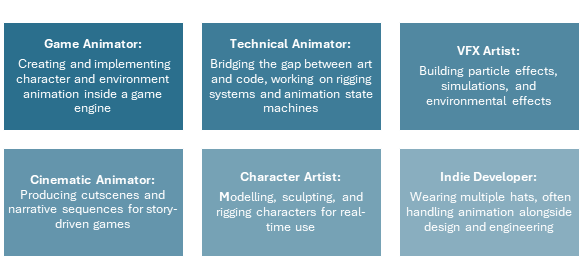
Globally, the animation and gaming sector supports approximately 1.5 million creative professionals, with investment in the field growing by 26% between 2023 and 2025. Studios report that the demand for technical and artistic roles remains high even during periods of restructuring in the industry.
For students who want to step into this field with a structured programme, the MA Game Design programme at BSBI School of Business and Innovation offer pathways specifically built around industry-relevant skills and creative development.
AI Tools for Animation in GaminG
Artificial intelligence is changing how animation gets produced, not replacing animators, but shifting how much time is spent on the technical versus creative work.
- Cascadeur’s AI Inbetweening is one of the most practical examples: it uses machine learning to generate natural motion between key poses, handling transitions that would previously take hours to refine manually.
- Mixamo’s auto-rigging uses automated algorithms to apply skeletons to uploaded characters in seconds — a process that once required significant manual work.
- DeepMotion and RADiCAL both offer markerless motion capture from video, meaning you can record yourself moving on a phone camera and translate that into usable 3D animation data.
- Runway Gen-4 is being used for concept animation and plate cleanup in production pipelines. Adobe Sensei, embedded in Adobe’s creative tools, powers features like Content-Aware Fill and smart masking that save significant time in compositing work.
The tools themselves are still in rapid development. What’s worth understanding now is the underlying shift: AI is handling more of the technical grunt work, which raises the floor on what all animators can produce — but it also raises the bar on creative decision-making, timing and storytelling.
Conclusion
There isn’t one right answer to which software is best for animation in gaming. There’s a right answer for your goals, your current skill level and where you want to end up.
Blender is an excellent first step for almost everyone. Maya is worth knowing if studios are where you’re heading. Spine and Toon Boom are worth the time if 2D is your focus. And tools like Cascadeur and Unreal Engine are worth adding once you’ve established a base.