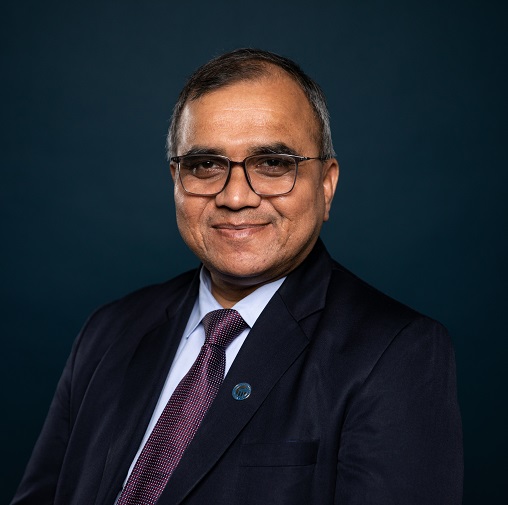
Dr. Shiv K. Tripathi
Dean of Faculty of Economics and Business Administration
Dr. Shiv K. Tripathi verfügt über zweieinhalb Jahrzehnte Erfahrung in Lehre, Forschung und Hochschulmanagement. Er war Vizekanzler der Atmiya University, India.
Überblick
Dr. Shiv K. Tripathi verfügt über zweieinhalb Jahrzehnte Erfahrung in Lehre, Forschung und Hochschulmanagement. Er war Vizekanzler der Atmiya University, India. Zuvor war Shiv in verschiedenen Funktionen in Indien und im Ausland tätig, darunter als Professor und Dekan an der IIHMR University, Jaipur; Executive Director (Management) an der Chandigarh University, Mohali; Senior Professor und Dekan an der CMR University, Bengaluru; Vizekanzler der Mahatma Gandhi University, Meghalaya; Professor und Dekan für strategische Planung und internationale Beziehungen an der CMR University, Bengaluru; Professor und Leiter des Bereichs Business Studies am Mzumbe University Dar Es Salaam Campus (Tanzania) sowie Dekan der Faculty of Management an der VBS Purvanchal University (India).
Dr. Tripathi war als Gastdozent und Gastforscher tätig für Programme der Coventry University (UK) und des Indian Institute of Foreign Trade (India) in Tanzania sowie an der HEC, Paris; der University of Witwatersand, South Africa; der ISAE, Brazil; und dem Birla Institute of Technology and Science (BITS) Pilani. Als Trainer und Moderator arbeitete Prof. Tripathi mit mehreren Unternehmen und Institutionen zusammen, darunter die National Thermal Power Corporation (India), die International Society for Advancement of Scientific Publications (INASP, UK) und die Southern African Regional Universities Association (SARUA). Seine Unternehmenserfahrung umfasst Beratungs- und Vorstandsmandate bei verschiedenen Unternehmen in Indien, Südafrika und Tansania, darunter eine dreijährige Beratungstätigkeit bei University of Stellenbosch Executive Education Limited, South Africa.
Dr. Tripathi hielt eingeladene Vorträge auf verschiedenen internationalen Konferenzen in Indien, Brasilien, Ägypten, Deutschland, Kenia, Malawi, Polen, Rumänien, Südafrika, der Schweiz und den USA. Zudem war er regelmäßig als Gastredner in einem CEMS-Masterkurs an der University of St. Gallen (Switzerland) tätig.
Er ist Mitglied der Global Working Groups der United Nations Principles for Responsible Management Education (PRME) zu „Anti-Corruption in Management Curricula“ und „Poverty Eradication through Management Education“. Dr. Tripathi engagierte sich aktiv für die Verbreitung einer auf nachhaltige Entwicklung ausgerichteten Hochschulbildung in Indien und Ostafrika. Dies erfolgte durch gemeinsame Initiativen mit United Nations Academic Impact (UNAI) und UN Principles for Responsible Management Education (PRME). Er ist gewähltes Vorstandsmitglied des Humanistic Management Network (HMN) und leitet dessen India Chapter. Shiv wurde von der Flourish Prize Initiative, der Case Western Reserve University (USA) und den UN Principles for Responsible Management Education (PRME) gemeinsam als „Pioneering Professor“ für die Förderung einer auf nachhaltige Entwicklung ausgerichteten Bildungsinitiative ausgezeichnet.
Er erwarb zunächst einen Bachelorabschluss in Electrical and Electronics Engineering und anschließend einen Masterabschluss in Business Administration. Seine wegweisende Doktorarbeit über vergleichende Managementphilosophien des Ostens und Westens bildete die Grundlage für die Veröffentlichung von „Corporate Yoga“ (IAP, USA, 2017). Shiv absolvierte das International Faculty Programme (IESE, Barcelona), das Management Teachers Programme Certificate (IEDC, Bled), das International Programme on Management of Sustainability Certificate (University of Tilburg) sowie das Management Teachers Programme des Strategic Management Forum. Letzteres umfasste eine Reihe von sechs Programmen an führenden indischen Business Schools, darunter IIM-Ahmedabad, IIM-Lucknow, IIM-Kozhekode, XLRI und IIFT.
Fachgebiete
- Lehre nach der Fallstudienmethode
- Strategie und Nachhaltigkeit
- Ethik
- Verantwortungsvolle Lieferketten
- Hochschulmanagement
Forschungsinteressen
- Verantwortungsvolle Unternehmensführung
- Ethik im Management
- Hochschulmanagement
Publikationen
Bücher
- Amann, W.C. Gupta, P. & Tripathi, S. K. (Eds.). (2022). Heartful leadership: A primer for transforming education. Walnut Publication, India.
- Amann, W.C. Tripathi, S,K., Arora, N., Singh, S.P. & Pandey, O. (Eds.). (2021). 10th year of United Nations Academic Impact: Inaugural conference proceedings and stakeholder’s reflections. Golden Signature Research and Consulting, India.
- Amann, W.C. & Tripathi, S.K. (2020). Higher education management: Leading with ethics and transparency. Walnut Publishing, India.
- Tripathi, S.K. & Amann, W.C. (2017). Corporate Yoga: A primer for sustainable and humanistic leadership. Information Age Publishing, USA.
- Amann, W.C., Stachowicz-Stanusch, A., Tripathi, S. & Khan, S. (Eds). (2017). Responsible executive education. Winterwork Borsdorf, Germany.
- Amann, W.C., Tripathi, S.K., Khan, S. & Janardhanam, K. (2017). Making management studies matter: Phronesis 2.0 in business schools and companies. Himalaya Publishing House, Mumbai.
- Amann, W.C., Berenbeim, R., Tan, T.K. Kleinhempel, M., Lewis, Al., Nieffer, R., Stachowicz-Stanusch, A. & Tripathi, S. (2015). Anti-corruption: Implementing curriculum change in management education. Greenleaf Publishing, UK.
- Amann, W.C., Khan, S., Stachowicz-Stanusch, A. & Tripathi, S.K. (Eds.). (2013). Executive education in B-schools. Winterwork, Germany.
- Amann, W.C., Kerretts-Makau, M., Fenton, P., Zackariasson, P. & Tripathi, S. (Eds.). (2012). New perspectives on management education. Excel Books, New Delhi.
Fachzeitschriftenartikel
- Tripathi, S.K. (2022). Managing sustainable change in higher education institutions: Towards phronetic vision development. Association of Indian Universities Journal – University News, 60 (12), 100 – 105.
- Amann, W.C. & Tripathi, S.K. (2019). The path towards becoming a socially responsible business school—the case of Canara Bank school of management studies India. South Asian Journal of Business and Management Cases, 8 (3), 251-261.
- Tripathi, S. L. and Tripathi & S.K. (2019). Managing university community partnership (UCP) for sustainable development: Perspectives regarding development of a generic governance model. International Journal of Research and Analytical Reviews, 6(1), 810-813.
- Filho, W.L., Tripathi, S. K., Andrade Guerra, J.B.S.O.D., Giné-Garriga, R., Orlovic Lovren, V. & Willats, J. (2018). Using the sustainable development goals towards a better understanding of sustainability challenges. International Journal of Sustainable Development & World Ecology, 26(2), 179-190.
- Amann, W. C. & Tripathi, S.K. (2018). Achieving sustainable strategic advantage through inclusive business: Reflections from selected cases. Optimization: Journal of Research in Management, 10 (1), 12-17.
- Tripathi, S.K. & Amann, W.C. (2016). Role of management education in fighting private sector corruption: Some persectives on turning business ethics to action. Sankalpa – Journal of Management and Research, 6 (Special), 198 – 201.
- Rosenbloom, A., Vishwanath, K.R., Tripathi, S.K. & Ross, D. (2014). Integrating sustainability in MBA/ EMBA programmes: A two country comparison. International Journal of Case Method Research and Application, XXV (1),50 – 65.
- Tripathi, S.K., Amann, W.C., Pandey, P., & Mukhi, U. (2014). The philosophy and science of corporate yoga: Some perspectives on responsible management action. International Journal of Vedic Foundations of Management, 1 (2), 68 – 81.
- Tesha, C.P., Tripathi, S.K. & Kimeme, J. A. (2014). Evolution of supply chain management practices in sub-saharan Africa: Some insights. Procurement and Supply Management Journal, 11, 4-8.
- Kimeme, J.A. & Tripathi, S. (2013). The influence of sponsors’ management philosophy on project management in Tanzania: An analysis of critical issues in internationally funded projects. International Journal of Philosophy of Management, 12 (2), 71-87.
- Tripathi, S.K. & Mukhi, U. (2013). The spiritual triology of human action for ethical business responses: Moving towards corruption-free zone. International Journal on Spirituality and Organizational Leadership, 1 (2), 107 – 117.
- Beatus, C., Tripathi, S.K. & Kasongwa, L. (2013). Important issues in growth of Islamic banking services in east African context: Study of selected banks in Dar Es Salaam, Tanzania. International Journal of Research in Business and Technology, 3 (2), 169 – 176.
- Tripathi, S.K. & Lal, S. (2013). Policy framework and challenges in research process value- chain standardization in Indian universities. HEF Indian Journal of Higher Education, IV (I), 90 – 97.
- Tripathi, S.K. (2012). Organizational innovations and responses for universal equilibrium: Symposium introduction. International Journal of Organization Theory and Behavior, 15 (4), 497 – 501.
- Zomboko, F.E., Tripathi, S.K. & Kamuzora, F.K. (2012). Challenges in procurement and use of Donated medical-equipments: study of a selected referral hospital in Tanzania. Research World – Journal of Arts Science and Commerce, 4(1), 41-48.
- Lubasha, A.J. and Tripathi, S.K. (2012). Vocational education program quality in Tanzania: Study of stakeholders perception in Dar Es Salaam region. International Journal of Management & Information Technology, 1 (3), 118-132.
- Tripathi, S.K. (2012). The contribution of Prof. S.K. Chakraborty to the human values in management. 3D – IBA Journal of Management and Leadership, 4 (1), 43 – 45.
- Edson, M., Tripathi, S.K. & Kasongwa, L. (2012). Assessing team-culture dynamics in a Tanzanian hospital: A pilot study in a selected multi-specialty hospital in Dar Es Salaam. Amity Global HRM Review, 2 (4), 22 – 28.
- Mungaya, M., Mbwambo, A.H. & Tripathi, S.K. (2012). Study of tax system impact on the growth of small and medium enterprises (SMEs): With reference to Shinyanga municipality, Tanzania. International Journal of Management and Business Studies, 2 (3), 99-105.
- Lemenge, F. & Tripathi, S.K. (2011). Critical issues in realizing best-value through strategically aligned supply chains: A study of selected manufacturing companies in Tanzania. Management Convergence – An International Journal of Management, I (2), 32-44.
- Tripathi, S.K. & Petro, G. (2010). Evolving green procurement and sustainable supply chain practices in the organizations: A framework to align functional strategy implementation to organization’s corporate social responsibility (CSR) objectives. Management Convergence – An International Journal of Management, I (1), 24-32.
- Tripathi, S.K. (2010). Shunya poems (book review). Journal of Xavier’s Institute of Management, VII (2), 221 -224.
Weitere Artikel
- Tripathi, S.K. (2020, November 27). NEP 2020: Need to Reform University Regulations. Indian Observer Post, https://indianobserverpost.in/News-Detail.aspx?Article=949&WebUrl=web
- Tripathi, S.K. & Amann, W.C. (2020, August 1). New education policy: Time for re-defining vision and mission in Indian universities. India CSR, https://indiacsr.in/new-education-policy-time-for-re-defining-vision-and-mission-in-indian-universities/
- Tripathi, S.K. & Sachdeva, C. (2020, August 4). COVID-19: Why healthcare supply chains need greater transparency? TEN News and India CSR, https://tennews.in/covid-19-why-healthcare-supply-chains-need-greater-transparency/
- Amann, W.C. & Tripathi, S.K. (2020, May 7). COVID 19: Time for solidarity and corporate moral responsibility. CEEMAN News, http://www.ceeman.org/news/covid-19-time-for-solidarity-and-corporate-moral-responsibility
- Tripathi, S.K. & Amann, W.C. (2020, April 15). COVID-19 and higher education: Learning to unlearn to create education for the future.” United Nations Academic Impact, https://www.un.org/en/academic-impact/covid-19-and-higher-education-learning-unlearn-create-education-future
- Tripathi, S.K. & Nyamsogoro, G.D. (2015, August 3). Africa’s business schools must champion anti-corruption education. The Conversation Africa, http://theconversation.com/africas-business-schools-must-champion-anti-corruption-education-44380
- Tripathi, S.K. (2015, June 5). African management courses must be focused on local priorities. The Conversation Africa, http://theconversation.com/african-management-courses-must-be-focused-on-local-priorities-40572
Buchkapitel
- Tripathi, S.K. & von Kimakowitz, E. (2022). Workplace spirituality: Drivers, challenges and way forward. In Gupta, P., Bhatnagar, T. & Sahni, S.P. (Eds.). Spirituality and Management: From Models to Applications, Springer, Singapore, 181-191.
- Tripathi, S.K. & Amann, W.C. (2022). Yogic leadership approach: Linking spirituality and management for harmonized human responses. In Gupta, P., Bhatnagar, T. & Sahni, S.P. (Eds.). Spirituality and Management: From Models to Applications, Springer, Singapore, 155-165.
- Amann, W.C., Tripathi, S.K. & Gupta, P. (2022). Heartful leadership for transforming education and driving humanism and sustainability. In Amann, W.C., Gupta, P. & Tripathi, S.K. (Eds.). Heartful leadership: A primer for transforming education, Walnut Publications, India, 1-8.
- Amann, W.C., Gupta, P. & Tripathi, S.K. (2022). Conclusion. In Amann, W.C., Gupta, P. & Tripathi, S.K. (Eds.). Heartful leadership: A primer for transforming education, Walnut Publications, India, 83-85.
- Amann, W.C., Tripathi, S.K. & Khan, S. (2016). Driven by customers or driving customers: what really should matter in executive education. In Lepeley, M.T. von Kimakowitz, E. & Bardy, R. (Eds.). Human Centered Management in Executive Education, Palgrave Macmillan.
- Tripathi, S.K., Mukhi, U. & Molteni, M. (2016). Innovation in sustainable entrepreneurship education in Africa: strategy and social impact. In Nicolopoulou, K., Karatas-Ozkan, M., Janssen, F. & Jermier, J. (Eds.). Sustainable Entrepreneurship and Social Innovation, Routledge.
- Tripathi, S.K., Prakash, A. and Amaan, W.C. (2015). Management education with poverty alleviation focus: A framework for curriculum design and Pedagogical alignment. In Gudic, M., Parkes, C. & Rosenbloom, A. (Eds.). Responsible Management Education and Challenge of Poverty: A Teaching Perspective, Greenleaf, UK.
- Tripathi, S.K. (2013). Integrating Anti-corruption teaching and research in management education: a framework for giving voice to values (GVV) based approach. In Stachowicz-Stanusch, A. & Hansen, H.K. (Eds.). Teaching Anticorruption: Developing a Foundation for Business Integrity, Business Expert Press, New York, 109-128.
- Kaminyoge, N., Madale, M. & Tripathi, S.K. (2013). Work-stress and job performance in government offices: Study of a selected ministry in Tanzania. In Shukla, S., Malusare, R. & Deshpandey, A. (Eds.). Management Innovation and Interventions for Sustainable Development, Excel India Publishers, New Delhi, 538-544.
- Sulle, A. & Tripathi, S.K. (2013). The employee performance management systems implementation in public service organizations: Study of a selected district council in Tanzania. In Shukla, S., Malusare, R. and Deshpandey, A. (Eds.). Management Innovation and Interventions for Sustainable Development, Excel India Publishers, New Delhi, 531-537.
- Kiwoli, R. & Tripathi, S.K. (2013). Customers’ perception of healthcare service quality in Tanzania. In Shukla, S. & Morande, S. (Eds.). Management Practices and Strategies in Dynamic Global Environment, Lancer’s Books, New Delhi, 475-485.
- Tripathi, S.K., Amann, W.C. & Kamuzora, F. (2013). Towards a humanistic and responsible managerial decision making model: the corporate Ubuntu approach.’ In Khan, S. & Amann, W.C. (Eds.). World Humanism: Cross-Cultural Perspectives on Ethical Practices in Organizations, Palgrave Macmillan, 122-134.
- Amann, W.C., Kerretts-Makau, M., Fenton, P., Zackariasson, P. & Tripathi, S.K. (2012). An overview of new perspectives on management education. In Amann, W.C., Kerretts-Makau, M., Fenton, P., Zackariasson, P. and Tripathi, S.K. (Eds.). New Perspectives on Management Education, Excel Books, New Delhi.
- Tripathi, S.K. (2012). Teaching-research synchronization in business schools: a conceptual framework for aligning the research value chain. In Amann, W.C., Kerretts-Makau, M., Fenton, P., Zackariasson, P. & Tripathi, S.K. (Eds.). New Perspectives on Management Education, Excel Books, New Delhi.
- Amann, W.C., Kerretts-Makau, M., Fenton, P., Zackariasson, P. & Tripathi, S.K. (2012). Concluding thoughts. In Amann, W., Kerretts-Makau, M., Fenton, P., Zackariasson, P. & Tripathi, S.K. (Eds.). New Perspectives on Management Education, Excel Books, New Delhi.
Lehrfallstudien
- Tripathi, S.K., Amann, W.C. & Zwaanstra, M. (2015). East meets west, leadership at test. HEC Paris Teaching Case Series. HEC Paris.
- Tripathi, S.K. & Ali, M. (2012). ABN University A: The change came. Case Centre, UK (Erstwhile European Case Clearing House), Product: 312-230-1).
- Tripathi, S.K. & Ali, M. (2012). ABN University B: Is the change over? Case Centre, UK (Erstwhile European Case Clearing House) (Product: 312-231-1).
- Tripathi S.K., & Kamuzora, F. (2010). The Strategy – structure challenge in university transformation: A case of Mzumbe University, Tanzania. Higher Education Management Certificate Training Material, Southern African Regional Universities Association, Johannesburg.
- Tripathi S.K., (2010). Even sky is not the limit: A case of Alagappa University transformation. Mzumbe University Teaching Case, Tanzania.
Konferenzen, Vorträge und Redebeiträge
- Internationale Konferenz zum Thema „Mahabharata for Effective Management’ (2 Tage, November 2010).
- UN Academic Impact Launch and Inaugural Conference, UN Headquarters, New York (2 Tage, November 2010)
- Pan Commonwealth Forum 6, Kocchi, India (4 Tage, November 2010).
- South Zone Vice Chancellor’s Conference (2 Tage, Juni 2010).
- PRME Working Group Meeting and Curriculum Development Workshop, Copenhagen Business School, Denmark (1 Tag, April 2011).
- UN Global Compact Annual Forum 2011, UN Regional Headquarters, Copenhagen, Denmark (2 Tage, April 2011).
- PRME Working Group Meeting and Curriculum Development Workshop, Buenos Aires, Argentina (1 Tag, Dezember 2011).
- PRME Latin-America Conference, Buenos Aires, Argentina (2 Tage, Dezember 2011).
- PRME Working Group Meeting and Curriculum Development Workshop, Rio de Janeiro, Brazil (1 Tag, Juni 2012).
- UN Global Compact Annual Forum 2012, Rio de Janeiro, Brazil (2 Tage, Juni 2012).
- Rio + 20 Summit, Rio de Janeiro, Brazil (3 Tage, Juni 2012).
- I5th International Anti-Corruption Conference, IACC, Brasilia, Brazil (3 Tage, November 2012).
- LEED Fellow Capacity Building Programme, Chancellor’s College, Lilongwe, Malawi (1 Tag, November 2012).
- PRME Working Group Meeting and Curriculum Development Workshop, Humboldt University, Berlin, Germany (1 Tag, Juni 2013).
- Humanistic Management Network Annual Conference, University of St. Gallen, Switzerland (2 Tage, Juni 2013).
- United Nations Global Compact 10th Principle (Anti-Corruption) Working Group Meeting, New Delhi, India (1 Tag, April 2013).
- PRME Working Group Meeting and Curriculum Development Workshop, New York (1 Tag, Dezember 2013).
- UN Global Compact International Anti-Corruption Day Conference (1 Tag, Dezember 2013).
- British Council Going Global Conference 2014, Miami Beach Convention Centre, Miami, USA (3 Tage, April 2014).
- UN Global Compact EU Conference, WHO Headquarters, Geneva, Switzerland (2 Tage, Juni 2014).
- PRME Global Forum 2015, New York, USA (2 Tage, Juni 2015).
- 2nd International conference zum Thema „Global Convergence of Management Practices and Education,’ Canara Bank School of Management Studies, Bangalore University, India, (2 Tage, November 2015).
- International Conference and PRME Asia Meeting, Goa Institute of Management, Goa, India (1 Tag, November 2015).
- PRME Round Table at 5th Internationale Konferenz zum Thema „Impact of Business Ethics, Governance and CSR on Society,’ Gujrat Technological University, India, (2 Tage, Februar 2016).
- PRME Middle East and North African (MENA) Region Conference, American University in Cairo, Egypt (2 Tage, April 2016).
- International Conference on Business and Management in Emerging Economies (ICBMEM 2016), Zanzibar (3 Tage, 2016).
- International Conference on Sustainability (SUSCON VI) at Indian Institute of Management, Shillong, India (2 Tage, März 2017).
- Nationaler Capacity-Building-Workshop zum Thema „Gender Equality in Higher Education’, Canara Bank School of Management Studies, Bangalore University, India (2 Tage, März 2017).
- 12th International Summer School of Neurology, Eforie Nord, Romania (2 Tage, Juli 2017).
- PRME Global Forum, New York (1 Tag, Juli 2017).
- 1st International Anti-Corruption Working Group Conference, Fordham University, New York, USA (1 Tag, Juli 2017).
- Dialogue of Civilization Annual Forum and Conference, Rhodes Island, Greece (2 Tage, September 2017).
- Internationale Konferenz „Making Management Studies Matter’, Canara Bank School of Management Studies, Bangalore University, India (2 Tage, November 2018).
- 7th Humanistic Management Network Annual Conference, University of Jagiellonian Krakow, Poland (2 Tage, Oktober 2019).
- Internationale Konferenz zum Thema „Small Business’ (Online, 27th Jun 2020).
- 8th Humanistic Management Network Annual Conference (Online, 3-5 Nov 2020).
- Responsible Management Education Research Conference (Online, 18-19 Nov 2020).
- International Conference on Business and Management in Emerging Economies Symposium, (Online, 14th Dec 2020).
- UN Principles for Responsible Management Education (PRME) Global Forum Sitzung zum Thema „Fighting Corruption: Way Forward in Business and Academia (Online, 16th June 2021).
- 9th Humanistic Management Network Conference India Country Sitzung zum Thema „Humanistic Solutions for Society 5.0’ (Online, 25th Nov 2021).
- West Zone Vice-Chancellor’s Conference (Online, 7th Dec 2021).
- Symposium zum Thema „Building the World-Class Universities,’ (2 Tage, Dezember 2021).
- Internationale Konferenz zum Thema „Disruptive Business Models for Sustainability,’ (Online, 16th Dec 2021).
- Strategic Management Forum (SMF) 25th Anniversary Symposium and Case Method Workshop (Online, 21st Jan 2022).
- Sitzung zur Förderung der Zusammenarbeit zwischen Wissenschaft und Industrie bei der jährlichen globalen Konferenz PRADANYA 2022 zum Thema „Innovations in Healthcare and Education – The Decade of Acceleration for Global Goals’ (Online, 10th Feb 2022).
- Virtual Round-Table Conference on ‘Improving Student Employability and Modernizing Curriculum’ (Online, 17th Feb 2022.
- CSR and Sustainability Summit Podiumsdiskussion zum Thema „21st Century Skills and Edtech Interventions, Bengaluru (1 Tag, Februar 2022.
- Series of four (04) Focus Group Workshop cum Symposium on Responsible Business Conduct in International Supply Chains, (Hybrid Online/Offline, 3rd Feb, 5th Feb, 21st Feb and 21st Mar 2022).
- AIU Annual Meeting and All India Vice Chancellor’s Conference (2 Tage, März 2022).
- 23rd World Education Summit Sitzung zum Thema „Creating a synergy between technology and curriculum for better employment ready courses – How can digitalization help this goal’ (Online, 26th Mar 2022).
- 7th Annual Conference of the International Association for Silk Road Studies (IASS 2022) zum Thema „The Roles of Universities in the Era of Artificial Intelligence (AI) and Big Data (BD): Challenges and Opportunities’ (Online, 5th April, 2022).
- 10th Humanistic Management Conference (24th Nov 2022, online)
- Association of Indian Universities (AIU) West-Zone Vice Chancellor’s Conference (21st January, 2023)
- 15th Biennial Conference of Entrepreneurship Development Institute of India (22nd January, 2023)
Auszeichnungen und Ehrungen
- Strategic Management Forum (SMF) Alumni Award 2021 am Indian Institute of Management, Nagpur, verliehen am 30. Dezember 2021.
- Sarvapalli Rashakrishnan National Award of Teaching Excellence 2020, verliehen von der National Teachers Welfare Foundation und Bharat Sanchar Nigam Limited, Government of India (5. September 2020).
- Visionary Leader Award, verliehen von der Indo-Global Chamber of Commerce, Industries and Agriculture (18. August 2018).
- Anerkennung durch die Anti-Corruption Working Group des PRME Secretariat, New York, für seinen Beitrag zu einem Antikorruptions-Toolkit für MBA-Curricula im Rahmen der 1st International Anti-Corruption Conference of UN Principles for Responsible Management Education (20. Juli 2017).
- Besondere Auszeichnung für seinen Beitrag zur Förderung verantwortungsvoller Managementausbildung im Rahmen der 5th International Conference on „Impact of Business Ethics, Governance and CSR on Society“, organisiert vom Centre for Business Ethics and Corporate Social Responsibility der Gujrat Technological University, India (6. Februar 2016).
- Gemeinsame Auszeichnung als „Pioneer Professor“ durch die Flourish Prize Initiative, die Case Western Reserve University (USA) und das UN Principles for Responsible Management Education (PRME) Secretariat für die Förderung einer auf nachhaltige Entwicklung ausgerichteten Bildungsinitiative (24. Juni 2015).